3D movies formats: Blu Ray 3D, SBS 3D or Anaglyph 3D
 221
221 0
0
Blu-Ray 3D
Blu-Ray 3D is a new format for distributing 3D movies based on the H. 264 Advanced Video Coding (AVC) codec and files with the SIFF extension. As a carrier, ordinary BD25 or BD50 disks are used. The format itself is a subspecies of a separate stereo pair in Dualstream.
The main difference is that a special MVC (Multiview Video Codec) based on the AVC stereo profile is used for video compression, which was originally designed for compressing stereo pairs. The main*. M2TS file contains the left angle and a special "3D" flag for 3D players. And the SIFF subdirectory contains information that allows you to calculate the right angle based on the left angle. With this encoding, you can save ~25% of disk space. The accuracy of the synchronization of the camera angles is provided not by the player, but by the compression format itself.
Watch 3D movies in format - Blu-Ray 3D
Half-SBS 3D (Side-by-Side)
Stereo pair - a pair of flat images of the same object (subject), which have differences between the images, designed to create the effect of volume. The effect occurs due to the fact that the parts of the plot located at different distances from the observer when viewed from different points (corresponding to the right and left eyes) have different angular displacement (parallax). When viewing a stereo pair in such a way that each eye perceives only the image intended for it, the illusion of observing a three-dimensional picture is created (see binocular vision). The stereo pair is used to demonstrate spatial images of objects in stereoscopic cinema, stereophotography, stereoscopic television, virtual reality systems, and for scientific purposes.
As a rule, a classical stereo pair consists of images arranged horizontally next to each other at a distance corresponding to the interpupillary distance of a person. To view such a stereo pair, the direction of the eye's gaze has to be placed in parallel, as if we were observing a very distant object, which requires special efforts when viewing stereo pairs. To simplify the perception, a pair of images can be placed with the superimposition of one on the other, while the separation of pairs occurs due to different colors (see anaglyph), different polarization or time separation (for example, pairs flicker alternately on the screen; special glasses are used to ensure visibility for each of the eyes only at the moment when the desired image is displayed). In the described cases, glasses of various designs are used to observe stereo pairs.
Side-by-Side 3D - frames are arranged horizontally relative to each other. In turn, it is divided into two subspecies: Cross and parallel stereo pairs. Parallel: The left image is for the left eye, and the right image is for the right eye. To view such a stereo pair, the direction of the eye's gaze has to be placed in parallel, as if we were observing a very distant object, which requires special efforts when viewing stereo pairs. Cross: The left image is for the right eye, and the right image is for the left eye. To view such a stereo pair, we have to cross our eyes as if we are observing a very close object, which is easier than when viewing parallel stereo pairs.
Anamorphic SideBySide - Anamorph horizontal stereo pair / Anamorph SideBySide / Half SideBySide is a full-size horizontal stereo pair compressed in half horizontally to the size of the standard resolution and frame ratio (for DVD 720x480) or (for Blu-Ray 1920 x 1080) with a change in the proportions of the frame ratio of each angle (elongated faces).
This method is convenient for viewing at home on players (external, built-in TV) that are limited to the maximum supported image resolution of 1920 x 1080 pixels. or the transmission interface / cable does not allow you to transmit a picture larger than 1920 x 1080 pixels. It is for these reasons (2D standard and bandwidth) that an anamorphic stereo pair with a picture resolution of 1920 x 1080 pixels. It is the standard for 3D television.
Watch 3D movies in format -Side-by-Side
Full-SBS 3D (Full Side-by-Side)
Full-SBS 3D Movies (VR 3D format) - frames are arranged horizontally relative to each other. In turn, it is divided into two subspecies: Cross and parallel stereo pairs. Parallel: The left image is for the left eye, and the right image is for the right eye. To view such a stereo pair, the direction of the eye's gaze has to be placed in parallel, as if we were observing a very distant object, which requires special efforts when viewing stereo pairs. Cross: The left image is for the right eye, and the right image is for the left eye. To view such a stereo pair, we have to cross our eyes as if we are observing a very close object, which is easier than when viewing parallel stereo pairs.

Full-SBS 3D 3840x1080p is a full-size horizontal stereo pair converted from a full Blu-ray disc with a frame ratio of 3840x1080p, which allows you to accurately convey the picture of the movie without cropping it (as on 1920x1080p)
This format is convenient for viewing at home on players (external, built-in TVs) or on VR devices that are now becoming very popular. At the moment, there are no full-fledged films shot in VR , so this format is most suitable for this!
All available VR movies can be found in the VR Movies category
OU 3D (Over Under)
Stereo pair - a pair of flat images of the same object (subject), which have differences between the images, designed to create the effect of volume. The effect occurs due to the fact that the parts of the plot located at different distances from the observer when viewed from different points (corresponding to the right and left eyes) have different angular displacement (parallax). When viewing a stereo pair in such a way that each eye perceives only the image intended for it, the illusion of observing a three-dimensional picture is created (see binocular vision). The stereo pair is used to demonstrate spatial images of objects in stereoscopic cinema, stereophotography, stereoscopic television, virtual reality systems, and for scientific purposes.
As a rule, a classical stereo pair consists of images arranged horizontally next to each other at a distance corresponding to the interpupillary distance of a person. To view such a stereo pair, the direction of the eye's gaze has to be placed in parallel, as if we were observing a very distant object, which requires special efforts when viewing stereo pairs. To simplify the perception of a pair of images can be placed with the superimposition of one on the other, while the separation of pairs occurs due to different colors (see anaglyph), of different polarization or time separation (for example, pairs flicker alternately on the screen; special glasses are used to ensure visibility for each of the eyes only at the moment when the desired image is displayed). In the described cases, glasses of various designs are used to observe stereo pairs.
Over Under 3D - frames are arranged horizontally relative to each other. In turn, it is divided into two subspecies: Cross and parallel stereo pairs. Parallel: The left image is for the left eye, and the right image is for the right eye. To view such a stereo pair, the direction of the eye's gaze has to be placed in parallel, as if we were observing a very distant object, which requires special efforts when viewing stereo pairs. Cross: The left image is for the right eye, and the right image is for the left eye. To view such a stereo pair, we have to cross our eyes as if we are observing a very close object, which is easier than when viewing parallel stereo pairs.
Watch 3D movies in format - Over Under 3D
Anaglyph 3D
Anaglyph 3D (from the Greek anáglyphos-relief) is a method for obtaining a stereo effect for ordinary images by using color coding of images intended for the left and right eyes. To get the effect, you need to use special (anaglyphic) glasses, in which instead of diopter glasses, special light filters are inserted, as a rule, for the left eye — red (red), for the right — turquoise (cyan). A stereo image is a combination of images of a stereo pair, in which the red channel shows a picture for the left eye (the right one does not see it because of the light filter), and in turquoise (blue-green)-for the right one. That is, each eye perceives an image colored in the opposite color.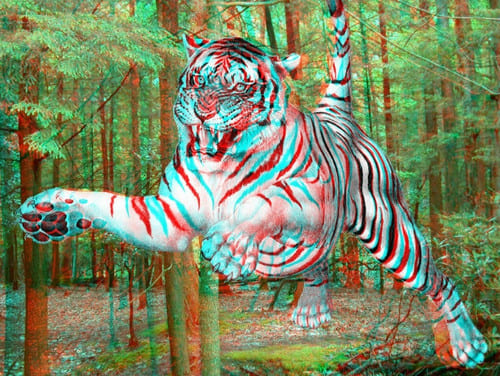
The main disadvantage of the anaglyph method is incomplete color reproduction. The resulting three-dimensional image, due to the effect of binocular color mixing, is perceived as monophonic or (at a certain brightness ratio) achromatic. The adaptation of the observer to the specific conditions of perception occurs quite quickly. However, after a not so long (about 15 minutes) stay in anaglyphic glasses, the observer's color sensitivity decreases for a long time (about half an hour) and there is a feeling of discomfort from the perception of the ordinary world.
This method of transmitting 3D images is already out of circulation. In cinemas, it is no longer used due to poor color reproduction, but the ease of use allows you to organize 3D viewing with minimal investment.
Watch 3D movies in format - Anaglyph 3D







 Add comment

